|
...Mould it and cast it in something solid with a
multi part mould
This How-to will tell you how to make a flexible mould
with a rigid support jacket for a
more complicated
piece, and then cast it in something solid so it
turns out the same as the original sculpt. This technique is used for items
with two or more sides to them which would otherwise be impossible to remove
from a one piece mould.
Be sure to read the
How-to on single sided moulds before attempting this.
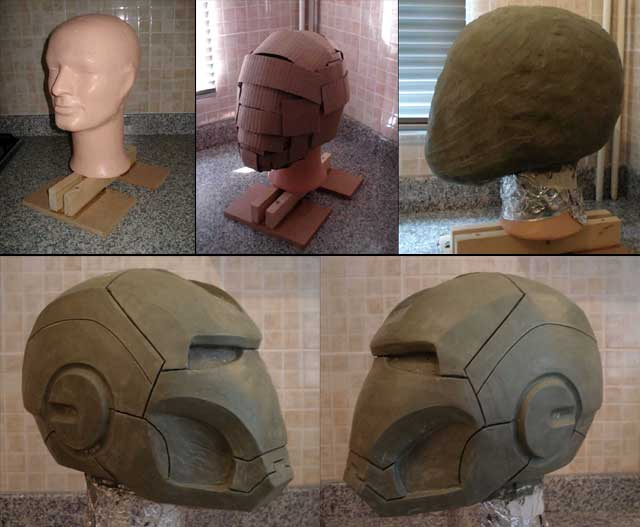
This item is a
helmet for a full size wearable costume. The
item is sculpted in an non-air drying, sulphur-free oil based clay. This clay is 'chemical free' so it will not affect the moulding
substance and cause any issues. The helmet has been sculpted over a
mannequin head and some cardboard so that it is not solid clay, which would
otherwise be costly and heavy.
Important: Oil Based Clay is reusable - you can use it
time and time again to make different sculpts once you've finished with the
moulding stage of the process.
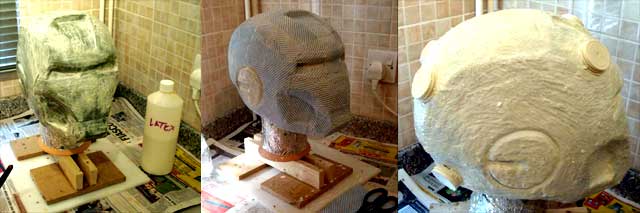
In the same way as the
single sided example, layers of latex and cloth were built up all over
the clay until the desired thickness was achieved. Some latex 'lumps' made
were made by layering up latex inside milk bottle tops which have been stuck
on in various places - these are to make a 'key' for the mould to fit inside
the rigid support jacket which is made in the next stage:
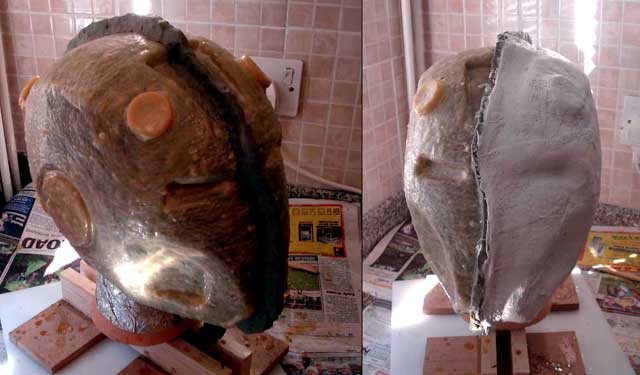
If we were to cover the item in plaster bandages as with the
single sided example, then of course the item would be stuck inside and
we wouldn't be able to remove it. Therefore we must make a two part support
jacket.
This is achieved by making a clay barrier on the outside of
the latex once it has dried. This barrier should divide the piece in half.
Half the rigid support jacket is then made from Modroc plaster of Paris
bandages:
After this, the clay barrier can be removed and the other
half of the support jacket applied. The exposed edge of the plaster jacket
should be covered with something to prevent the other half sticking to it -
paper masking tape works well for this, alternatively a petroleum jelly can
also be applied to the edge - but be careful not to get too much on the
latex.
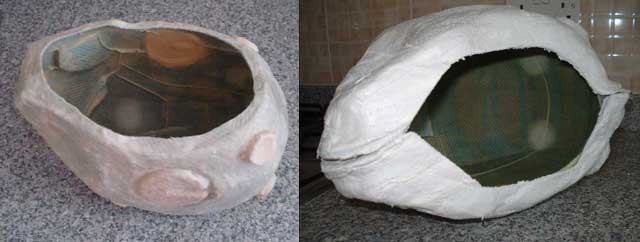
Here's the whole thing completely covered with Modroc, once
it's dry (allow 1-2 days for it to completely dry) it can be removed:
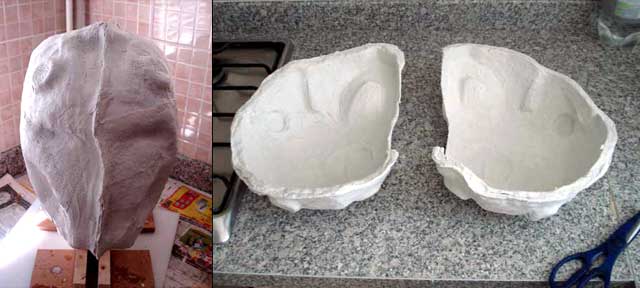
The latex and cloth mould can now be removed from the clay,
and everything reassembled leaving the middle hollow. You'll notice that the
latex mould it really quite flexible which is why the support jacket is
important:
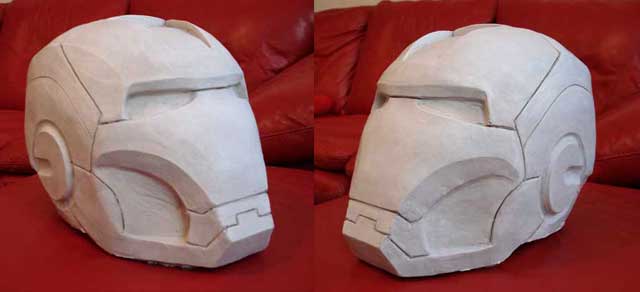
Now the piece can be cast inside the mould, and of course
multiple pieces can be made from it:
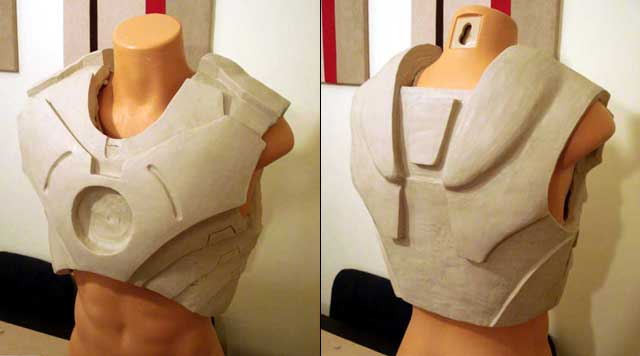
The next piece is the torso of the costume, and so it has a
front and a back to it. As with the helmet it has also been sculpted over a
mannequin form in order to save clay.
In the same way as the
single sided example, layers of latex and cloth were built up over the
clay. However, the front and back of the mould were first divided under the
arms and over the shoulders. This was done by sticking playing cards into
the clay in the appropriate places. The plaster bandage support jacket was also
divided along these lines so when the mould was removed it easily came into
two pieces:
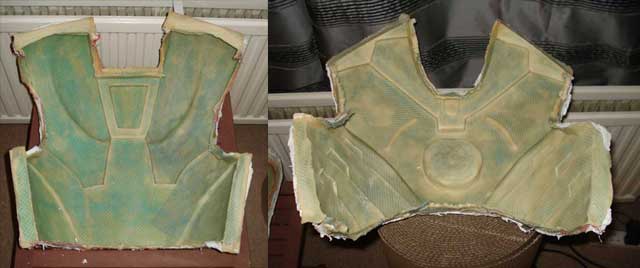
This allows the two haves to be laminated separately which is essential in
order that a person can get inside them when the costume is worn. Here are
the raw casts made from Jesmonite and glass fibre fabric:

After the pieces are sanded and filled to remove any imperfections as
required, they are primed and painted.
Warning: Always wear a suitable face mask when sanding items reinforced
with glass fibre.
The costume can then be assembled, in this case a flexible board called
Maplex Board was used along with some foam rubber and press studs to make
four tabs to attach the back and front together:

For the legs of the costume a multi-part mould was also used, but this time
we wanted to keep the item in once piece instead of having the finished
piece split in two. Again the original piece was sculpted in Oil Based Clay,
this time over wood and cardboard:
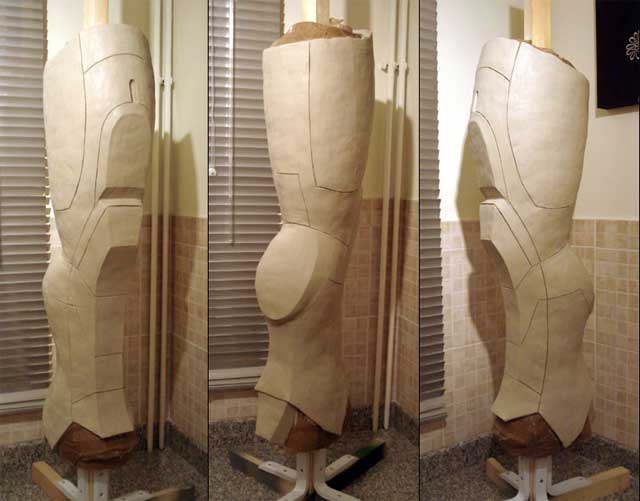
The sculpt is divided with playing cards, since this is the leg of the
costume it is split at the knee, and also split partially length-ways in
order that the mould can more easily be removed from the sculpt. In this
case the support jacket is made from Jesmonite and glass fibre fabric as
this is much stronger that Modroc:
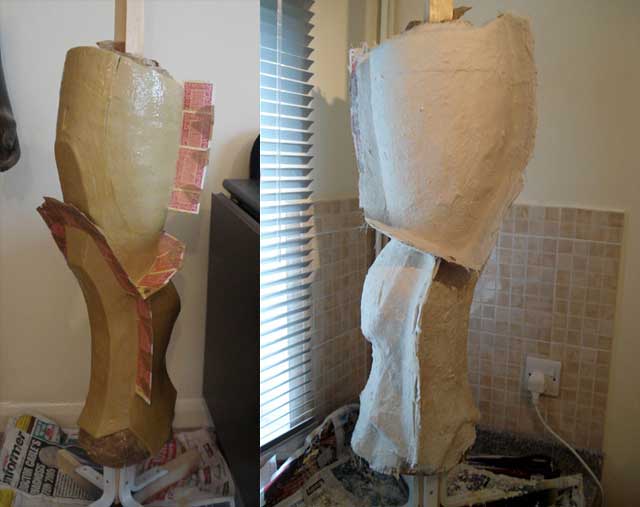
The support jacket splits into a total of four parts for the whole leg. Each
latex and cloth mould is left with a split in it along the same line as the
support jacket split:
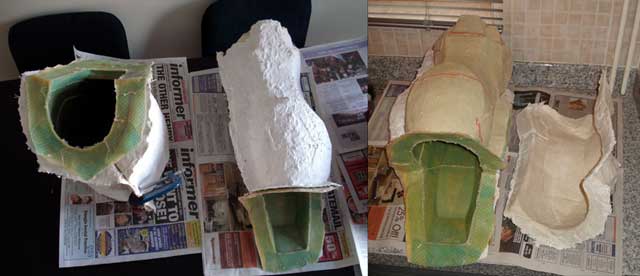
The finished pieces are cast from the inside of the mould in Jesmonite and
glass fibre fabric, sanded & filled as required, then primed and painted:
 |

